

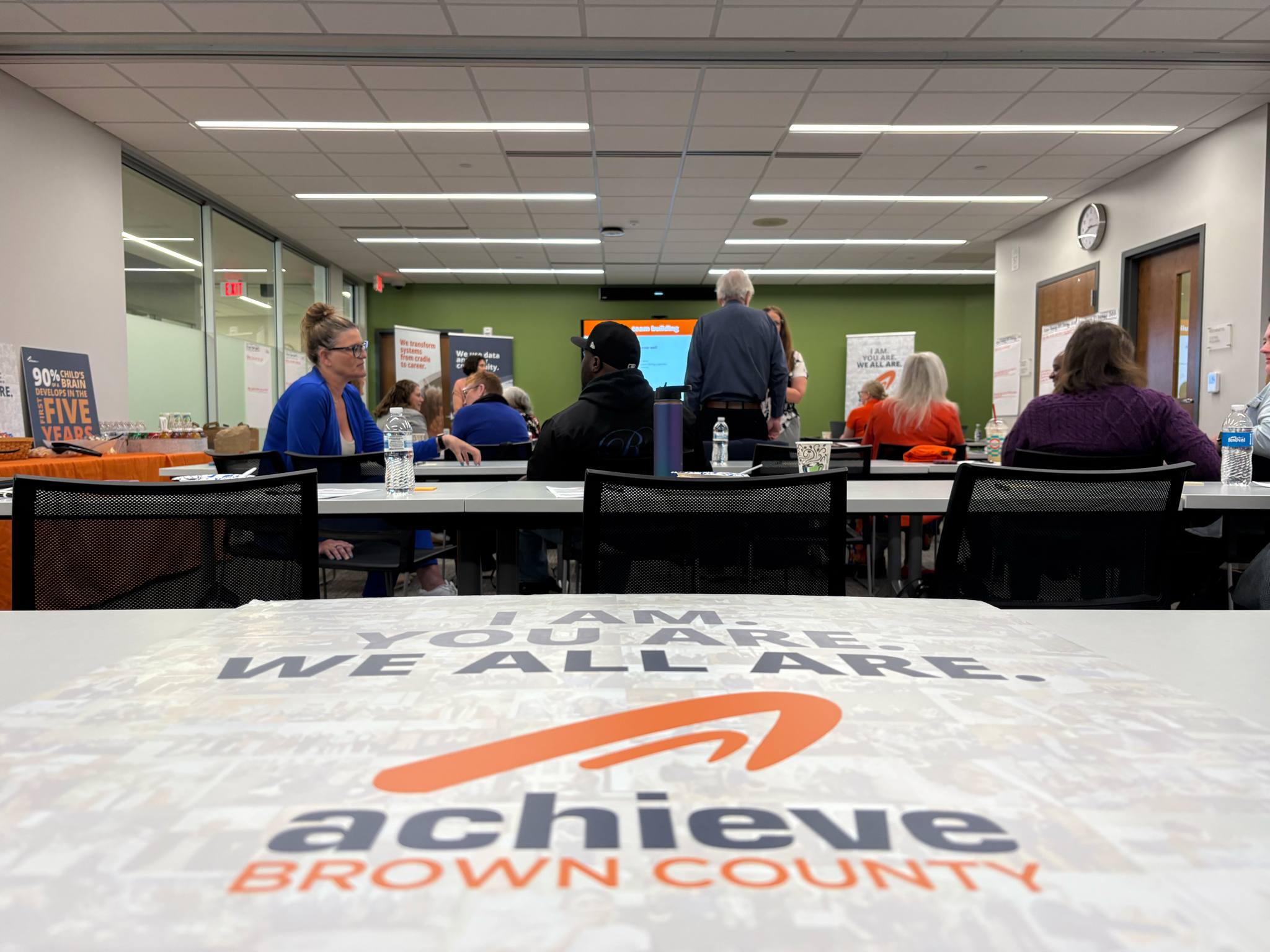
On May 8, 2025, over 30 community members from education, government, nonprofit, and business gathered at the Brown County Library–East Branch for Achieve Brown County’s Reading for the Future Spring Convening. This half-day event was filled with learning, collaboration, and collective planning around a shared vision: a Brown County where every young person can thrive. This convening focused on the Reading for the Future Initiative’s goal, that every third grader is reading at grade level.
Trust Across Partners
The morning began with focused efforts on building relationships and connections. Attendees paired off and were asked to reflect on personal or professional moments when systems failed individuals. Partners who participate in systems change actions realize that they have personal and professional stakes in this work. By participating in honest conversations about how we see ourselves or our organizations being one part of a complex system, we are all able to see how our individual roles can create change.


Building Relationships and Connections in one of the six conditions of systems change. Learn more about this condition here.
Action Team Updates
The Reading for the Future initiative currently has two Achieve Brown County staff led teams. These action teams shared out on their current work, including roster growth, purpose alignment, and the results they’re working toward. Team speakers from the Reading for the Future Strategy Team and Reading Begins at Birth Team encouraged attendees to reflect on themes, gaps, and collaboration opportunities as they listened. These cross-group report outs will be happening twice a year and are a reminder for all participants this work is long-game systems change, driven by the insights and action of our Partners.


Act 20 with Dr. Barb Novak
The convening’s first learning session was led by Dr. Barb Novak, Director of the Office of Literacy at the Wisconsin Department of Public Instruction. Her presentation broke down the core components of Act 20, a statewide literacy law passed in 2023, common misconceptions of this law, and what it means for communities and classrooms across Wisconsin.
She highlighted how Act 20 emphasizes explicit, systematic instruction, new assessment structures, and personal reading plans for struggling students. But Dr. Novak was also clear: implementation isn’t just about compliance—it’s about belief.
“It is about making sure that every child is able to read by the end of third grade and us all taking responsibility for that,” she said. “Making sure that every educator, every community member, every healthcare provider believes that every kid can, will, and must learn to read.”
Act 20 in Action
The second learning session featured a panel of Brown County school district leaders who are on the front lines of implementing Act 20:
- Rhoda Wood, Pulaski Community School District
- Dr. Amy LaPierre, School District of West De Pere
- Dr. Jamie Tyrrell, Green Bay Area Catholic Education
- Jess Malcore, Green Bay Area Public Schools
The panelists discussed how the legislation is showing up in their districts, how educators are adapting to the changes, and what early results are emerging. They also emphasized the importance of community partnership in supporting student success—especially as schools adjust to new instructional requirements and assessment protocols.


Action Planning
Reading for the Future Action Teams assembled into working groups to develop their next six-month plans using the Plan-Do-Study-Act framework. With support from Achieve Brown County facilitators, teams worked through goal setting, benchmarks, resources, and evaluation strategies. These planning sessions are critical to ensuring the work between convenings is focused, measurable, and rooted in shared accountability.
What’s Next
As attendees shared closing reflections and feedback, one theme was clear: progress is possible when we move forward together. Convening around a shared goal is one way the Collective Impact Partnership is keeping themselves as Partners engaged in the long game of systems change work. Partners planned this event to reaffirm their commitment to young readers and to hold each Partner accountable to the role we all play.
Next, the Reading for the Future Initiative teams will continue meeting separately to achieve their 6-month goals; one of which is creating a dashboard with community wide indicators around literacy. Stay tuned for more updates.


To stay connected, sign up for our Reading for the Future newsletter or follow us on Facebook and LinkedIn.